
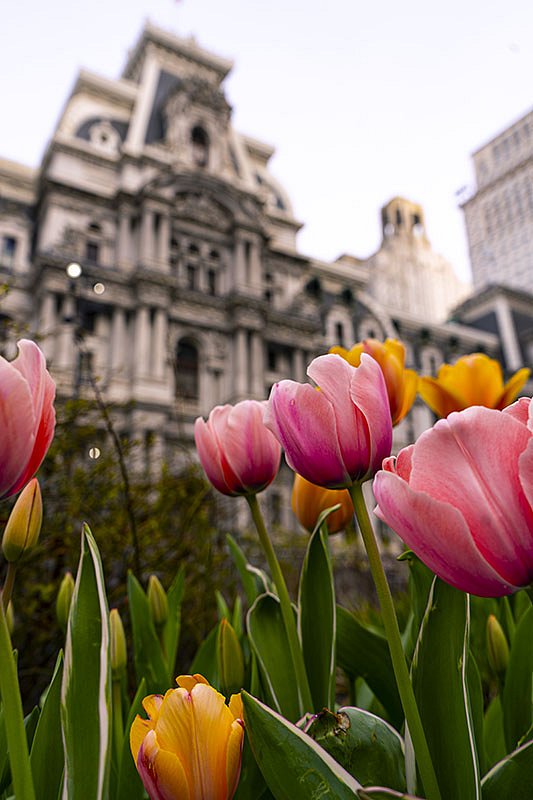
Tulips and Cityhall 1
Spring has sprung
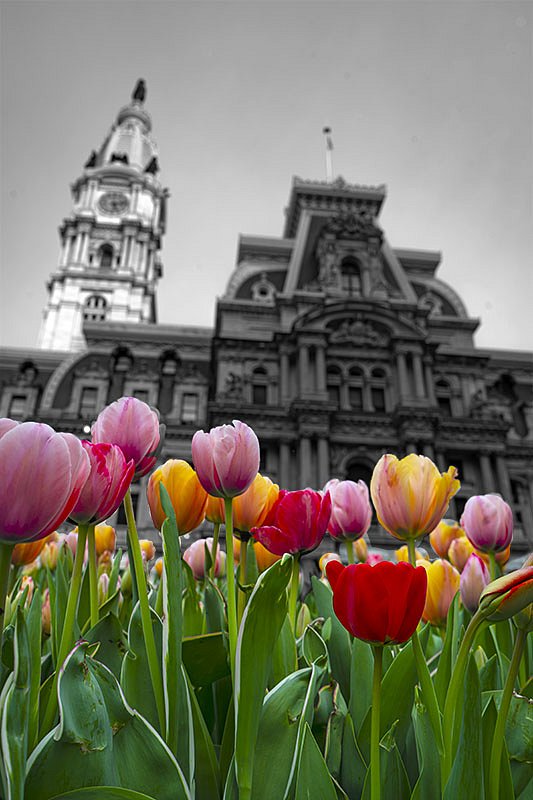
Tulips and Cityhall
Tulip season is here...


Snowman
keep smiling, even it is cold


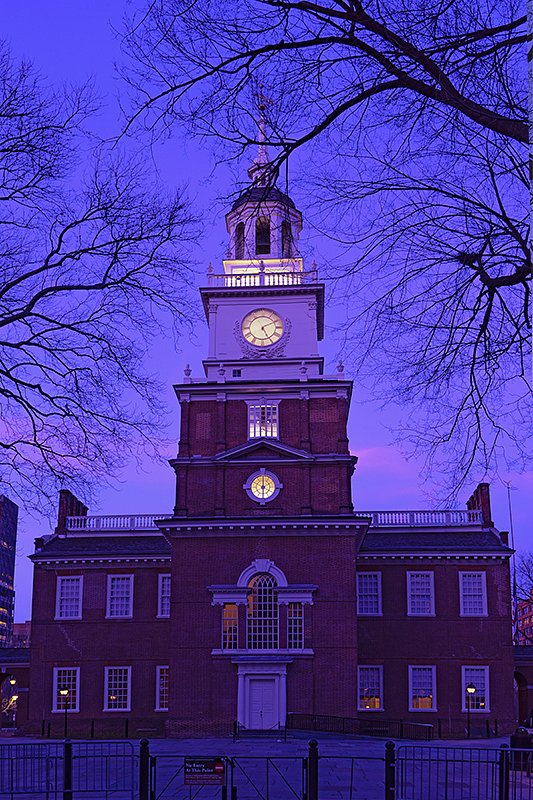
Independence Hall
Independence Hall touts a red brick facade, designed in Georgian style. It consists of a central building with belltower and steeple, attached to two smaller wings via arcaded hyphens. The highest point to the tip of the steeple spire is 168 feet 7 1⁄4 inches (51.391 m) above the ground.
The State House was built between 1732 and 1753, designed by Edmund Woolley and Andrew Hamilton, and built by Woolley. Its construction was commissioned by the Pennsylvania colonial legislature which paid for construction as funds were available, so it was finished piecemeal. It was initially inhabited by the colonial government of Pennsylvania as its State House, from 1732 to 1799.
In 1752, when Isaac Norris was selecting a man to build the first clock for the State House, today known as Independence Hall, he chose Thomas Stretch, the son of Peter Stretch his old friend and fellow council member, to do the job. In 1753 Stretch erected a giant clock at the building's west end that resembled a tall clock (grandfather clock). The 40-foot-tall (12 m) limestone base was capped with a 14-foot (4.3 m) wooden case surrounding the clock's face, which was carved by Samuel Harding. The giant clock was removed about 1830. The clock's dials were mounted at the east and west ends of the main building connected by rods to the clock movement in the middle of the building. A new clock was designed and installed by Isaiah Lukens in 1828. The Lukens clock ran consecutively for eight days, "with four copper dials on each side that measured eight feet in diameter and clockworks that ensured sufficient power to strike the four-thousand pound bell made by John Wilbank." The Lukens clock remained in Independence Hall until 1877.
The acquisition of the original clock and bell by the Pennsylvania Colonial Assembly is closely related to the acquisition of the Liberty Bell. By mid-1753, the clock had been installed in the State House attic, but six years were to elapse before Thomas Stretch received any pay for it. (wwikipedia)


Open air cafe
The new year brings a new air to the city. The new dining restrictions will start on January 16th. Indoor dining will be allowed again.


Ferris Wheel
A Ferris wheel (or a big wheel in the United Kingdom) is an amusement ride consisting of a rotating upright wheel with multiple passenger-carrying components (commonly referred to as passenger cars, cabins, tubs, capsules, gondolas, or pods) attached to the rim in such a way that as the wheel turns, they are kept upright, usually by gravity.
The original Ferris Wheel was designed and constructed by George Washington Gale Ferris Jr. as a landmark for the 1893 World's Columbian Exposition in Chicago. The generic term Ferris wheel, now used in American English for all such structures, has become the most common type of amusement ride at state fairs in the United States.
The current tallest Ferris wheel is the 167.6-metre (550 ft) High Roller in Las Vegas, Nevada, which opened to the public in March 2014. (wikipedia)


Winter Garden Dilworth PArk
Winter Garden Dilworth Park this year are packed with whimsically-crafted reindeer topiaries, seasonal plantings and an open-air layout


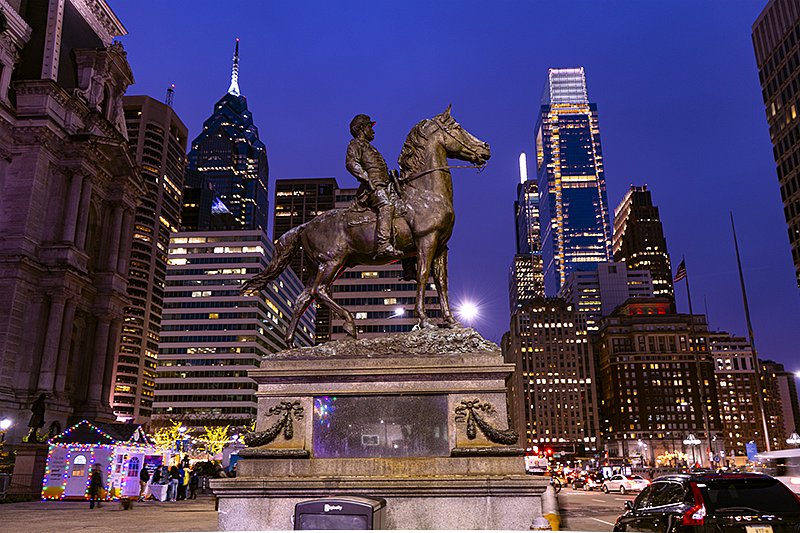
George B. McCloellan
George Brinton McClellan (December 3, 1826 – October 29, 1885) was an American soldier, civil engineer, railroad executive, and politician who served as the 24th Governor of New Jersey
.Artist : Henry Jackson Ellicott (1894)
Type Bronze
Dimensions 4.42 m × 1.5 m × 4.6 m (14 ft 6 in × 5 ft × 15 ft) (wikipedia)


Holiday tree at Rittenhouse Sq.
December is the month of decoration and celebration. Although it all starts with the same tradition ( tree lighting ceremony), each spot has their own style.
This holiday tree is quite small, and only decorated and lit by one color of lights. But it looked glowing and on fire after rain showers.


Holiday tree at Cityhall
The annual tradition of lighting a national tree dates back to December 24, 1923, when President Calvin Coolidge pressed a button that lit up more than 2,500 light bulbs strung around a 60-ft.-tall balsam fir tree from his home state of Vermont—reportedly personally felled in “the heart of the Green Mountains” by Middlebury College’s President Paul D. Moody and shipped express to Washington by the school’s alumni.
This year's(2020) tree is a 60-year-old white fir from Yule Tree Farms in New York that's more than 50 feet tall. For the holidays, it will be decorated with multi-color lights and painted ornaments. Two ornaments honoring the Black Lives Matter movement in Philadelphia and across the country are included this year.
(times.com,.phillyvoice.com)


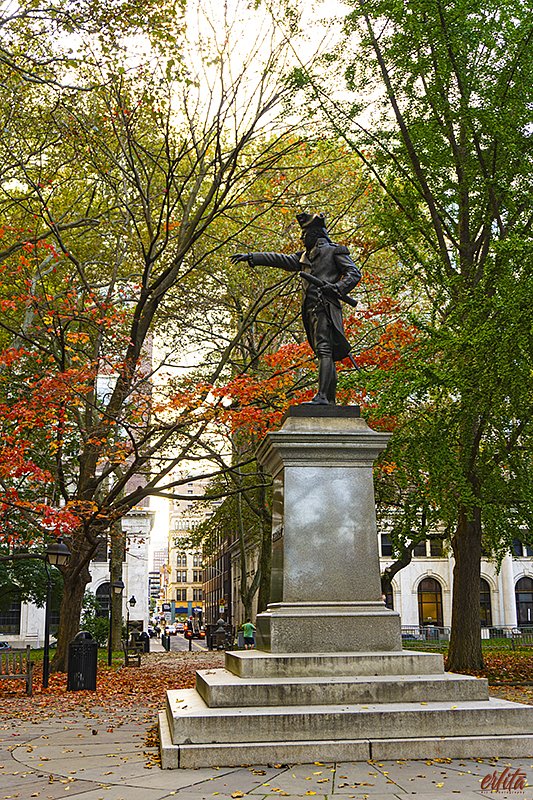
John Barry
John Barry (March 25, 1745 – September 13, 1803) was an Irish-American officer in the Continental Navy during the American Revolutionary War and later in the United States Navy. He has been credited as "The Father of the American Navy" (and shares that moniker with John Paul Jones, and John Adams) and was appointed a captain in the Continental Navy on December 7, 1775. He was the first captain placed in command of a U.S. warship commissioned for service under the Continental flag.
After the war, he became the first commissioned U.S. naval officer, at the rank of commodore, receiving his commission from President George Washington in 1797.
This bronze statue of John Barry (1745-1803) in Independence Square was sculpted by Samuel Murray (1869-1941), the artist who produced the statue of George Washington in front of Independence Hall. The statue was commissioned by the Friendly Sons of St. Patrick of Philadelphia, who then donated the statue to the City. The piece was modeled by Murray, probably in Philadelphia, in 1906. It was cast by the Roman Bronze Works of Brooklyn, NY. The pedestal was built by the Harrison Granite Co. of Barre, VT. A crowd of 15,000 witnessed the unveiling of the statue on March 16, 1907. A number of details are known about Samuel Murray's execution of the sculpture of John Barry. Murray generally worked from life or used photographs or earlier portraits. In both cases, he first modeled a nude figure to establish the anatomy correctly. Before modeling John Barry, Murray studied Gilbert Stuart's painting of Barry and had a friend pose in Barry's own Revolutionary War uniform. George Washington (ca. 1910; north of Independence Hall), Dr. Joseph· Leidy (1907; Academy of Natural Sciences), and-Rev. Corby (1910; Gettysburg battlefield) are other sculptures by Murray.
A few changes were made to the piece shortly after it was dedicated. In 1912, a bronze tablet was added to the north side of the pedestal, as the inscription cut in the stone was illegible from a distance. In 1913, Samuel Murray repaired a finger on the vandalized statue. In 1915, a change in the grading of the base of the statue was approved by the Art Commission.
(wikipedia, nps.gov)


Cozy under trees
A tree’s growth is based, in part, on competition from its neighbors. Its first priority is to gain access to the sun, and in a forest up is the only way to go.
But this explains why a tree grows tall, not how. How tall a tree will grow is dictated partly by its genes. A tree’s height is also dictated by environmental conditions. Most trees are capable of being taller than they actually are, they’re just limited by deficiencies in light, water, or nutrients.
The tallest trees on the planet are coast redwoods. why? It comes down to water – not so much water supply, but the physics of moving water. We all know trees need water and that it comes from the ground. Transporting water from the roots, on through the trunk, and up to the leaves is a challenge. Unlike in animals, a tree’s vascular system has no heart; there is no pump of any kind. Water is not pushed up the tree. Instead, it is pulled from above: water molecules tend to stick to each other and to other substances. When moisture evaporates from the surface of a leaf, it pulls along a column of water that extends all the way back to the roots. The water is pulled from the soil to replace what was lost above. As a tree grows taller, it becomes increasingly difficult to get water to its topmost leaves. Eventually, this leads to drought stress and reduced photosynthesis and growth.
All trees have to deal with this reality of physics, but those lanky redwoods deal with it better than any others. And according to some researchers, their superiority may derive largely from the fog in which they live. Gigantic redwoods exist only in a narrow band along a few hundred coastal miles in northern California. They grow in wet temperate forests in steep valleys, buffered against wind, and receive well over 100 inches of precipitation annually. These forests are marked by consistently cool, moist conditions and an abundance of fog.
Evidently, redwoods are able to absorb water from fog directly into their leaves. According to the National Park Service, stewards of the tallest of them, fog accounts for 40 percent of a redwood’s moisture intake. So instead of fighting against the physics of pulling hundreds of gallons of water from the soil through the tree’s complex – and really long – vasculature, they avail themselves of a more handy source. With access to water in the fog right near the leaves, the plumbing problem becomes something of a plumbing advantage.(northernwoodlands)


A hint of fall
The terms "fall" and "autumn" can be used interchangeably in the United States, though, when it comes down to it, it's actually the term "fall" that is more popular in America. "Autumn" came from the Latin word "autumnus," with the root of the word having connotations regarding "the passing of the year." The term "fall" was likely a deviation from the Old English words "fiaell" and "feallan," both of which mean "to fall from a height." It is assumed that this new name for the season was inspired by trees' falling leaves. (bustle)


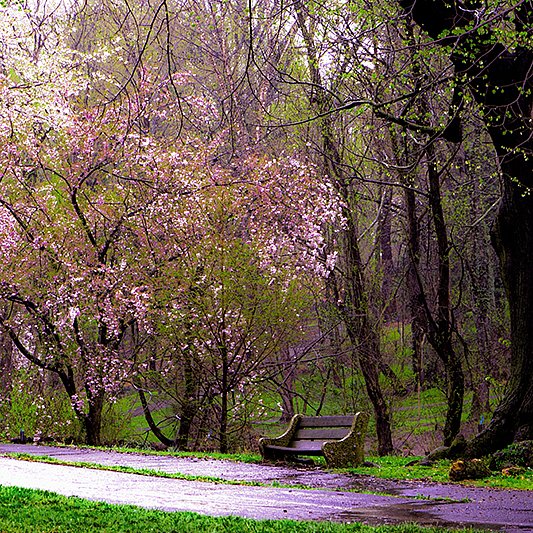
An Empty Bench
Silence is not empty, it is full of answers


Walking on falling cherry blossom
" Catching a falling cherry blossom makes your first love come true."
Cherry blossoms, also known as sakura in Japan, are the small, delicate pink flowers produced by cherry blossom trees.
Cherry blossoms hold elevated status in China, signifying love and the female mystique (beauty, strength and sexuality)
Tied to the Buddhist themes of mortality, mindfulness and living in the present, Japanese cherry blossoms are a timeless metaphor for human existence. Blooming season is powerful, glorious and intoxicating, but tragically short-lived — a visual reminder that our lives, too, are fleeting.
Sakura have therefore always signalled the beginning of spring, a time of renewal and optimism. With the blooming season coinciding with the beginning of the Japanese calendar year, they also bring hope and new dreams at a time. When n cherry blossoms are in full bloom, the future is bursting with possibilities
(notwithoutmypassport.com).


Rittenhouse Square- spring 2020
The park grounds was designed by renowned architect Paul Phillippe Cret. Cret, who also designed the original Barnes Foundation, the Rodin Museum and the Benjamin Franklin Bridge, designed Rittenhouse Square in 1913 and his vision remains today. Cret’s design creates many paths that carry pedestrian traffic through the park. At the center of the park is a central plaza which contains a reflecting pool and an ornately carved stone balustrade. Classical urns with ancient Greek inspired reliefs adorn the entrances of the square. The park also contains a number of significant pieces of public art including Antoine-Louis Barye’s “Lion Crushing a Serpent,” which was inspired by the French Revolution. The park is filled with benches and open green space to serve the thousands who use the park each day. Throughout the park, large century old trees provide ample shade for all who enjoy the square.
For many, Rittenhouse Square serves as the beautiful backdrop for their lunchbreak or their evening constitutionals. The square is also a popular gathering place for nearby young families; children running in the grass and parents pushing strollers is a common sight. But if you wish to do more than enjoy a stroll or relaxing picnic lunch, Rittenhouse Square is also home to a number of events. Rittenhouse Square plays host to flower markets, art shows, craft fairs and weekly farmer’s markets. There are also concerts in the square during the summer months and even a black tie gala. During the winter months Rittenhouse Square gets decked out for the holiday season and celebrations mark the lighting of the park’s Christmas tree and Menorah. All year long there is something happening in Rittenhouse Square. (theconstitutional.com)


Cityhall - spring 2020
The City hall of Philadelphia is always be the center of the heart of the city. All the skyscraper buildings are surrounding this area, All the activities are here all year around, either it is a parade, outdoor activities like marathon, outdoor "zumba" workout, ice skating, or entertainment like light show, christmas village, up to protest activities.


Schuylkill River Trail-Aramark
This shot was taken during the quarantine time in Philadelphia, fighting the virus of Covid19.
Mostly, the workouts that you can find here are running and biking. Walking your dog or just sit on the grass enjoying the weather with company or book are another activities people love to do here. Of course, with the face-mask on and practicing social distancing.
SIDE FACTS:
The Aramark headquarters moved into this location in 2018.
Situated along the Schuylkill River, the existing structure, originally built as a Hudson Motor Car Company plant in the 1920s, has been transformed into a modern, 600,000 square foot, nine-story building with an emphasis on innovation, sustainability and green space. Aramark occupied the top five floors and nearly 300,000 square feet as the building’s anchor tenant.
As a Fortune 200 global leader in food, facilities management and uniforms, this company employs about 1,200 people in the city and 6,800 in the Greater Philadelphia region


Schuylkill River Trail
The Schuylkill River Trail is a multi-use trail along the banks of the Schuylkill River in southeastern Pennsylvania. Partially complete as of 2018, the trail is ultimately planned to run about 140 miles (230 km) from the river's headwaters in Schuylkill County to Fort Mifflin in Philadelphia.

"%3ELibrary Hall Phildelphia ( side view)%3C/a%3E%3C/strong%3E%3C/p%3E%3Cp%3ELibrary+Hall%2C+at+105+South+5th+Street+is+a+1959+reconstruction+of+the+1790+building+originally+built+for+the+Library+Company+of+Philadelphia.+It+is+now+occupied+by+the+library+of+the+American+Philosophical+Society.%0A%0AFounded+by+Benjamin+Franklin+in+1743%2C+the+Philosophical+Society%27s+library+contains+an+unrivaled+collection+of+Franklin%27s+books+and+papers+as+well+as+those+of+other+great+scientists+from+then+until+now.%0A%0A%0ABuilt%3A+1789%0A%0AReconstructed%3A+1954%0A%0AOriginal+architect%3A+William+Thornton%0A%0A%0A%0AWHAT%27S+INSIDE%3A%0A%0A+The+original+journals+of+the+Lewis+and+Clark+expedition%2C%0A%0AA+copy+of+the+Declaration+of+Independence+in+Jefferson%27s+own+handwriting%2C+%0A%0AA+first+edition+of+Sir+Isaac+Newton%27s+Principia%2C+%0A%0AA+first+edition+of+Charles+Darwin%27s+Origin+of+Species%0A%0A%3C/p%3E)

Library Hall Phildelphia ( side view)
Library Hall, at 105 South 5th Street is a 1959 reconstruction of the 1790 building originally built for the Library Company of Philadelphia. It is now occupied by the library of the American Philosophical Society.
Founded by Benjamin Franklin in 1743, the Philosophical Society's library contains an unrivaled collection of Franklin's books and papers as well as those of other great scientists from then until now.
Built: 1789
Reconstructed: 1954
Original architect: William Thornton
WHAT'S INSIDE:
The original journals of the Lewis and Clark expedition,
A copy of the Declaration of Independence in Jefferson's own handwriting,
A first edition of Sir Isaac Newton's Principia,
A first edition of Charles Darwin's Origin of Species


Dolley Todd House
Located at on the northeast corner of 4th and Walnut Streets, the Todd House was built in 1775. It was occupied from 1791 -1793 by lawyer John Todd, and his wife Dolley Payne. Todd died during the 1793 yellow fever epidemic. Following her husband's death, Dolley married James Madison, later to become the fourth President of the United States. Dolley went on to serve as a de facto first lady for the widowed Thomas Jefferson in 1801, and as first lady during Madison's two terms... The Todd House reflects the lifestyle of 18th century Philadelphia's middle class.
Style : 18th century Georgian Built: 1775 Architect : Carpenters' Company member


Washington Square Park
Washington Square (Originally designated in 1682 as Southeast Square) is a 6.4 acres (2.6 ha) Open-space park in Center City, Philadelphia, The southeast quadrant and one of the five original planned squares laid out on the city grid by William Penn's surveyor, Thomas Holme. It is part of both the Washington Square West and Society Hill neighborhoods. In 2005, the National Park Service took over ownership and management of Washington Square, through an easement from the City of Philadelphia. It is now part of Independence National Historical Park.